Brief History
Bishop Martin High School officially opened on September 2, 2002, under the leadership of the La Inmaculada Parish Managing Committee and during the episcopacy of the Most Reverend Bishop Osmond Peter Martin. The institution initially operated on the grounds of the Pallottine Convent adjacent to La Inmaculada Roman Catholic Church in Orange Walk Town. In 2004, the school relocated to its permanent campus on San Lorenzo Road, where it now occupies 13 acres of land.
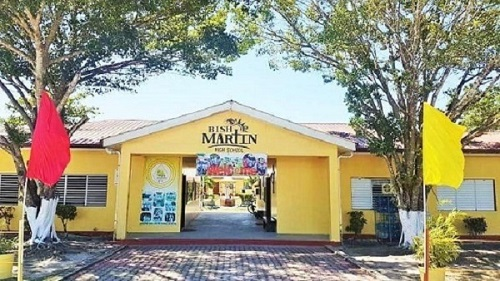
Front Entrance
Nicasio Hall
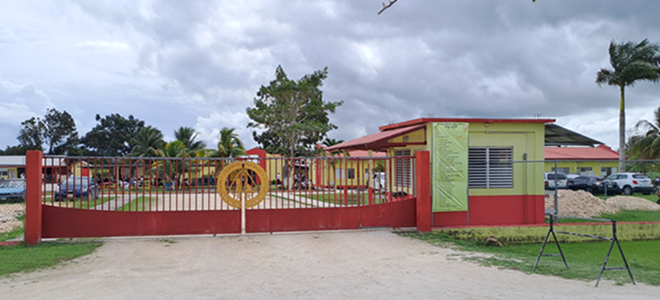
Main Gate
San Lorenzo Road
Orange Walk Town
The first principal of Bishop Martin High School was Mr. Rene Constanza, who served from 2002 to 2006. He was succeeded by Mrs. Maria Johnston, who held the post from 2006 to 2008, followed by Mrs. Flavia Burgos from 2008 to 2010. Mr. Luis Pook then served as principal from 2010 to 2019. As of August 1, 2020, the position of principal has been held by Mr. Angel Leiva.
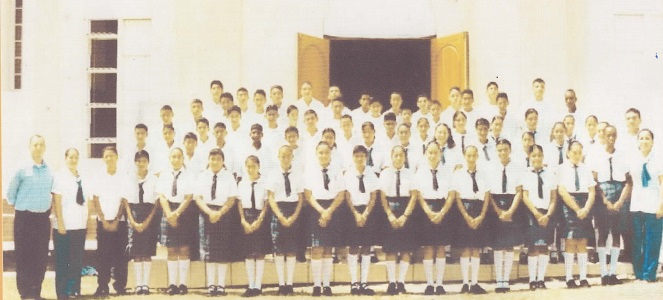
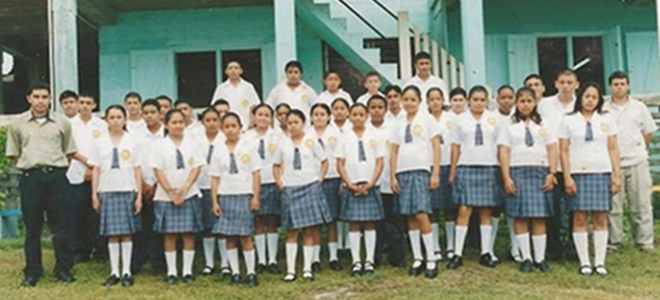
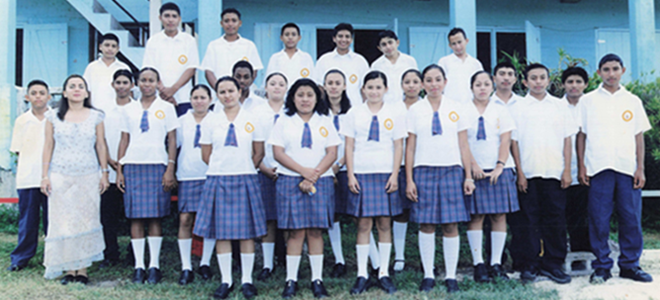
BMHS first cohort (August 29, 2002)
La Inmaculada Roman Catholic Church
Orange Walk Town
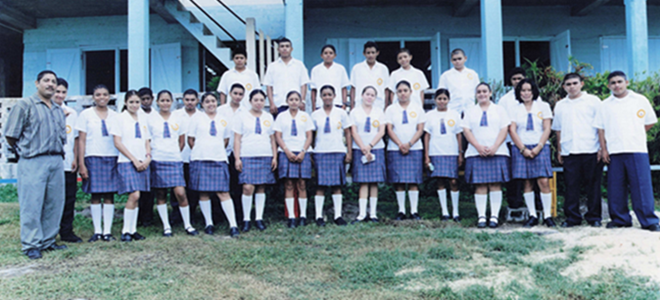
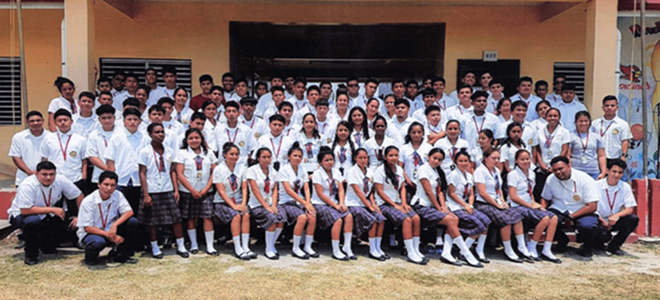
BMHS second cohort (2003)
Old BMHS Campus (Pallottine Convent)
Orange Walk Town
Mission Statement
Bishop Martin High School, in partnership with parents, guardians, La Inmaculada Concepcion Parish and the community, and in keeping with the teachings of the Roman Catholic Church and its traditions, provides accessible and affordable holistic education to students of diverse backgrounds.
Vision Statement
To be a leading education institution that prepares young people to be well-rounded citizens of the world and beyond
School Colors
Red: symbolizing Christ's love for humanity through his passion and death on the cross.
Yellow: symbolizing the universality of the Roman Catholic Church (papal colors)
School Logo
The logo is comprise of a Bishop's Miter set in a circular containing the school's name and motto. At the front of the miter is the depiction of La Inmaculada Roman Catholic Church and the Holy Bible as its foundation. The date of establishment is inscribed on the tail of the miter. The school logo is embellished with the school's colors.
School Flag
A red rectangular flag with the logo set in the center
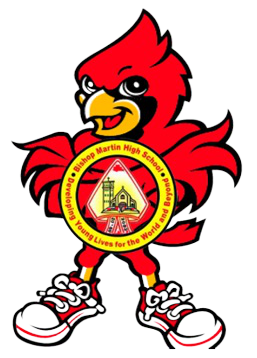
School Mascot
BMHS Cardinal
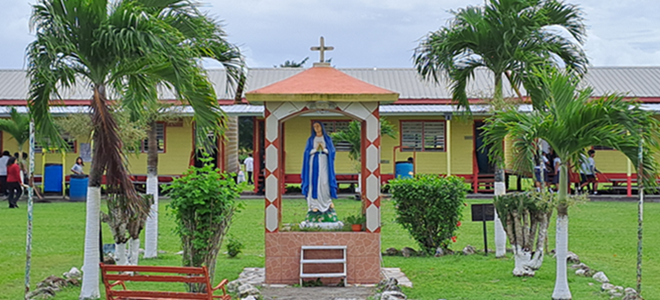
Cardinal Plaza
Our Lady of the Immaculate Conception
School Prayer
Lord GOD,
through San Juan Diego, You made known the love of Our Lady of Guadalupe
towards Your people. By his intercession, grant that we who follow the counsel of Mary, our
Mother, may strive continually to do God's will.
Amen
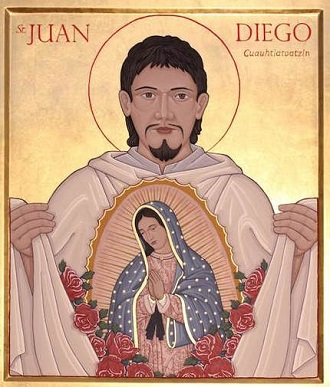
Patron Saint: San Juan Diego
Feast Day: December 9
San Juan Diego, born around 1474 in Cuauhtitlán near present-day Mexico City, is honored
as the first Indigenous saint of the Americas. His original Nahuatl name, Cuauhtlatoatzin,
translates to “Talking Eagle”. Juan Diego was a member of the Chichimeca people, a culturally
advanced and influential Indigenous group that lived throughout the Valley of Anáhuac, modern-day
Mexico City. He was baptized into Catholicism around 1524 by Franciscan priest.
Our Lady of Guadalupe appeared to Juan Diego over a four-day period, from December 9 to December 12,
1531, on Tepeyac Hill, which now forms part of modern-day Mexico City. During these apparitions,
the Virgin Mary requested that a church be built in her honor. When Franciscan Bishop Juan de Zumárraga
asked for a sign to confirm the authenticity of the visions, the Virgin provided a miraculous proof:
Castilian roses blooming in winter and her sacred image imprinted on Juan Diego’s tilma. This image,
now enshrined in the Basilica of Our Lady of Guadalupe in Mexico City, has become a profound
symbol of faith for millions across the world.
Following the apparitions, tradition holds that Juan Diego received permission from the Bishop to live
as a hermit in a small dwelling near the chapel erected at Tepeyac Hill. There he spent the remainder of his
life caring for the church and welcoming the first pilgrims who came to venerate the miraculous image.
His contemporaries regarded him as a man of deep holiness so much so that parents would bless their
children with the prayer, “May God make you like Juan Diego.” Juan Diego died in 1548, was beatified in 1990
and canonized by Pope John Paul II in 2002.